Weight of Memory
The ties that bind us to our roots, woven through the memories.

I remember walking home after Aleksandar Đuravčević's presentation at IED Firenze, bubbling with excitement as I talked to my best friend about his art. She remarked, "Wow, you’re so excited! I haven’t heard you like this in a while. In Montenegro, I never had the chance to encounter his works. No one mentioned him to me until I arrived in Florence. I was fascinated, but I couldn’t exactly tell whether it was because of him, the art, or a combination of both, blended with the moment where the interaction felt irresistibly familiar, like some kind of déjà vu.
In one of my conversations with him, I recalled Saša asking if I had visited one of the palazzos in Florence, though I couldn't quite remember which one. Of course, I hadn’t had time to see them all—there are so many in the city. I told him I didn’t know which one he was referring to. His reply to that was, 'Đe živiš ti?' ('Where do you live?'). I laughed because the question reminded me so much of my father; he would probably react the same way to my neglect of exploring every single corner of Florence. My father would have known every detail of the palazzos in Florence, probably having seen every one of them. Months later, after we had worked together for a while, I mentioned this moment to Saša. I told him he reminded me of my father: 'It’s so strange, the look someone gives you when you say they remind you of your father.' I felt the need to telepathically reassure him that I don’t have daddy issues—although, I might just be in denial. But it was strange how their way of communicating was so similar. They both have an inexhaustible source of knowledge, an endless library of quotes stored in their minds. They often speak with great wisdom, effortlessly and spontaneously. I’ll never understand how they manage to retain so much knowledge. It must be some kind of gift. I can’t recall their exact quotes because I’m not the one who remembers them—it’s their gift, not mine.
Saša was one of the artists selected for the final exhibition project of the Curatorial Practice course at IED, and as a fellow Montenegrin, I was naturally part of the group working with him. However, because we shared the same heritage, I didn’t want to immediately align myself with him. "Naši smo" (we are "ours"), as we say, and while that connection is important, I preferred to stay in the background, observing and stepping in only when I felt the need to steady the helm or steer the group in the right direction.
As I mentioned, Saša is a Montenegrin-born artist based in Brooklyn, New York. During the Yugoslav wars, he left the country and moved to Florence, where he studied at the Accademia di Belle Arti, before eventually relocating to NYC. Although I was born in 1993 and didn’t experience the war firsthand, I know the stories well. It was a time when the country was recruiting its own people to fight against friends, family, and acquaintances—essentially, the same people. Refusing the army’s call meant being branded a deserter, a fate punishable by death. Deserters were sent to the front lines and forced into the very first ranks, where they would be shot. This way, the military maintained the appearance of being blameless—there was no "evidence" of executions by their hand. During this time, my father was working on the restoration of frescoes at the Monastery of Žiča, where he met my mother. They married in 1992, the same year Saša fled the country as a deserter, seeking refuge in Florence. Meanwhile, my father narrowly avoided punishment and even execution, as Yugoslavia and its army rapidly disintegrated in the aftermath of the war.
Saša studied at the Accademia di Belle Arti in Florence, where he told me he received a scholarship, and later he specialized in graphic arts at Il Bisonte. Eventually, some of his family members moved to New York, so he joined them and continued his studies in printmaking at the Pratt Institute. The graphic influence is quite evident in his artistic manuscripts, especially his sense of typography. However, something else was constantly on my mind. I found myself thinking back to the time when he presented his work before we even started collaborating. Why did I feel so excited? Why was I so eager, as my friend said? I wanted to speak to him after the presentation, but he was surrounded by others with questions, leaving me to my thoughts. It felt like home; he felt like home. The kind of home you feel when you meet one of your own in a world that isn’t quite yours. In that sense, he felt like home. But how does that happen? How does someone you’ve just met, who presents their art to you, come to feel like home? He carries the essence of what he creates, and I recognize that feeling from my childhood. It was there when we played in the village of Dodoši, when my grandfather paddled me in his canoe on the river, and it was there when I found an old black-and-white photo of my great-grandmother with two other women at the entrance of the house in Dodoši, and my father shared with me their life stories. It was there when Saša shared how his grandmother travelled all the way from Montenegro to bring him food in Florence. That feeling of home and belonging, the feeling of remembering who we are, who our ancestors were, and what they did for us.
Through my research for the final project for my course, I read a lot about his work and what he does: “exploring the fluid nature of identity and the passage of time. He reflects on how memory influences perception, examining both personal histories and collective experiences, etc.” But when I read these things, they seem blunt, although accurate in description, but it doesn’t communicate the emotional weight of it. It’s as if I need to explain Botticelli's Venus to someone and say, “It’s a woman emerging from a seashell.” What do you feel when I say this? Nothing, absolutely. But when I saw her in real life, I burst into tears. Yet, being as analytical as I am, I am constantly on a quest to understand, define, and explain. The best way I can explain it is through these memories of a home I once had and remember but which no longer exists—a home that is lost.
I felt the weight of his art and didn’t want to influence my colleagues too much when discussing Saša's work, as my understanding and emotional connection to it were different from theirs. So, I adapted to the group dynamic, keeping my personal experience mostly to myself. They did an excellent job—we all did—and I’m incredibly proud of how everyone handled it with professionalism. However, Saša’s selflessness and support played a huge role in our success. Still, what I want to express here is how I felt about his work on a personal level, which is why I’m writing this.
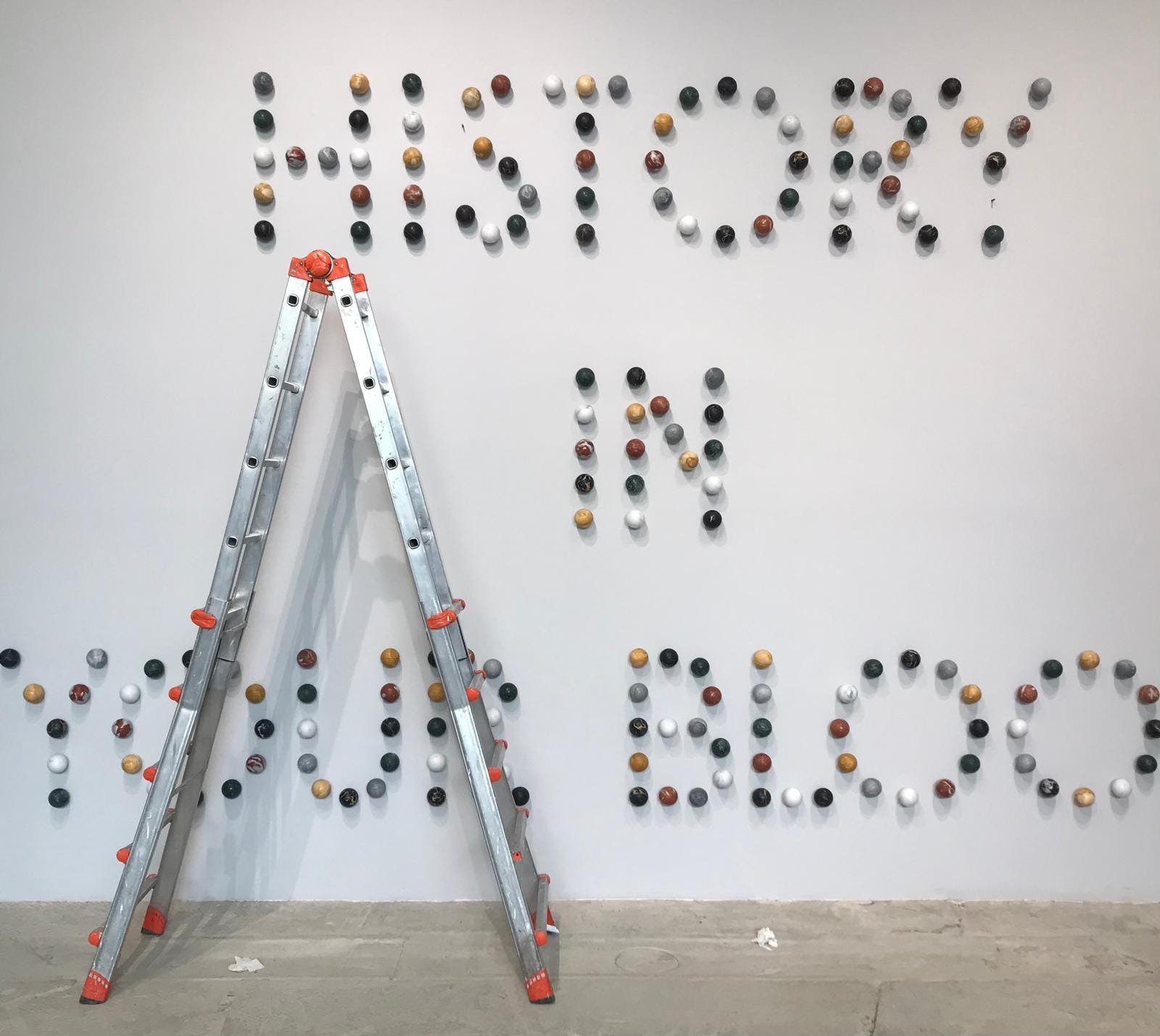
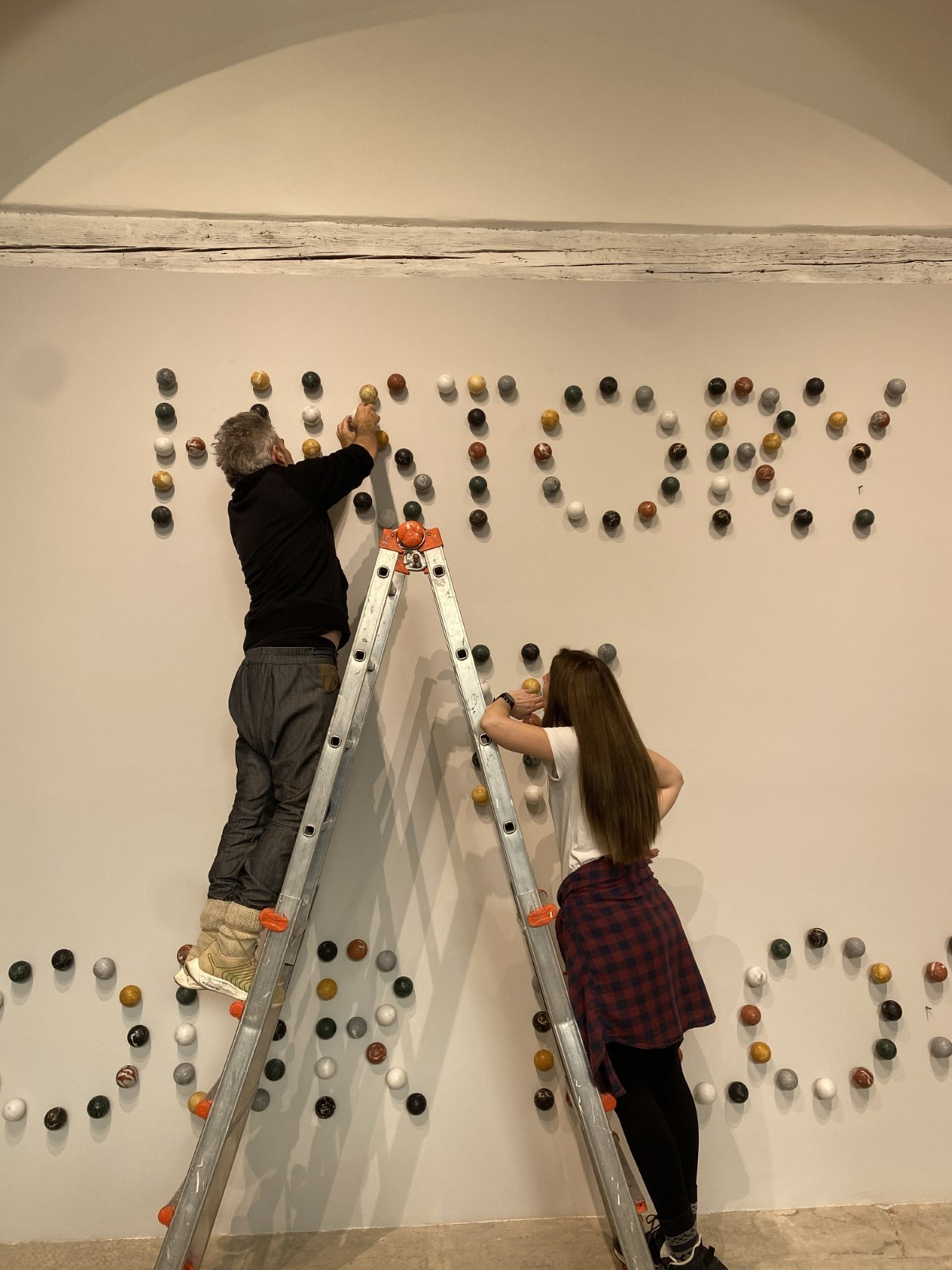
Let’s get straight to History in Your Blood. I won’t go into his collection Histories and Other Stories because many excellent curators have already written about it in formal terms, instead, I’ll share what I saw and how it affected me. At first, I was skeptical about the construction, mainly because, as a sculptor myself, I was curious to see how he would approach the design and execution. I won’t reveal his methods, but it’s clear he’s a professional. He’s one of the most established artists we’ve worked with, and his expertise was immediately evident. I said, “I’m not easily impressed,” but I’m impressed. His response? A simple smile. And truthfully, I was impressed.
Stone is particularly significant in Montenegro. We live in the rocks of the Montenegrin mountains, and life there is tough. Fortunately, collard grows well in those conditions, so at least we had something to eat. This context made the use of marble in his work feel deeply meaningful and nostalgic. The fact that he used marble from all over the world—Italy, Spain, France, Brazil—was fascinating to me. What impressed me most, though, was how he executed his ideas so cleanly and concisely. Often, artists are seen as chaotic, struggling to organize their thoughts. Saša is different. He’s three steps ahead. His approach reminded me more of an architect—organized, meticulous, with little room for error. Similarly, his attention to detail was remarkable, as seen in how he polished the spheres to reflect just the right amount of light. Naturally, this level of precision impressed a Virgo rising like myself. I helped him install and arrange them with the workers, every detail was considered with care.
Of course, being a double Gemini, Saša also expressed himself through letters and poetic elements in his work. He makes you think deeply but doesn’t offer an immediate conclusion. You’re left with more questions and more thoughts, and it continues long after you leave the installation. As someone who enjoys swimming in endless thoughts without feeling like they’ll drown, it felt natural. What stood out, though, was his humbleness and willingness to listen to suggestions for the arrangement of the pieces. This is not something you typically associate with a Gemini—they don’t listen, they talk. I witnessed him listen to multiple voices at once, processing them and thinking about what he should do, all that in real-time. He reminded me of something Andy Warhol said about Edie Sedgwick: “One person in the 60s fascinated me more than anybody I had ever known. And the fascination I experienced was probably very close to a certain kind of love.” I don’t usually admire men, but I found myself genuinely admiring him—not just as an artist but as a person.
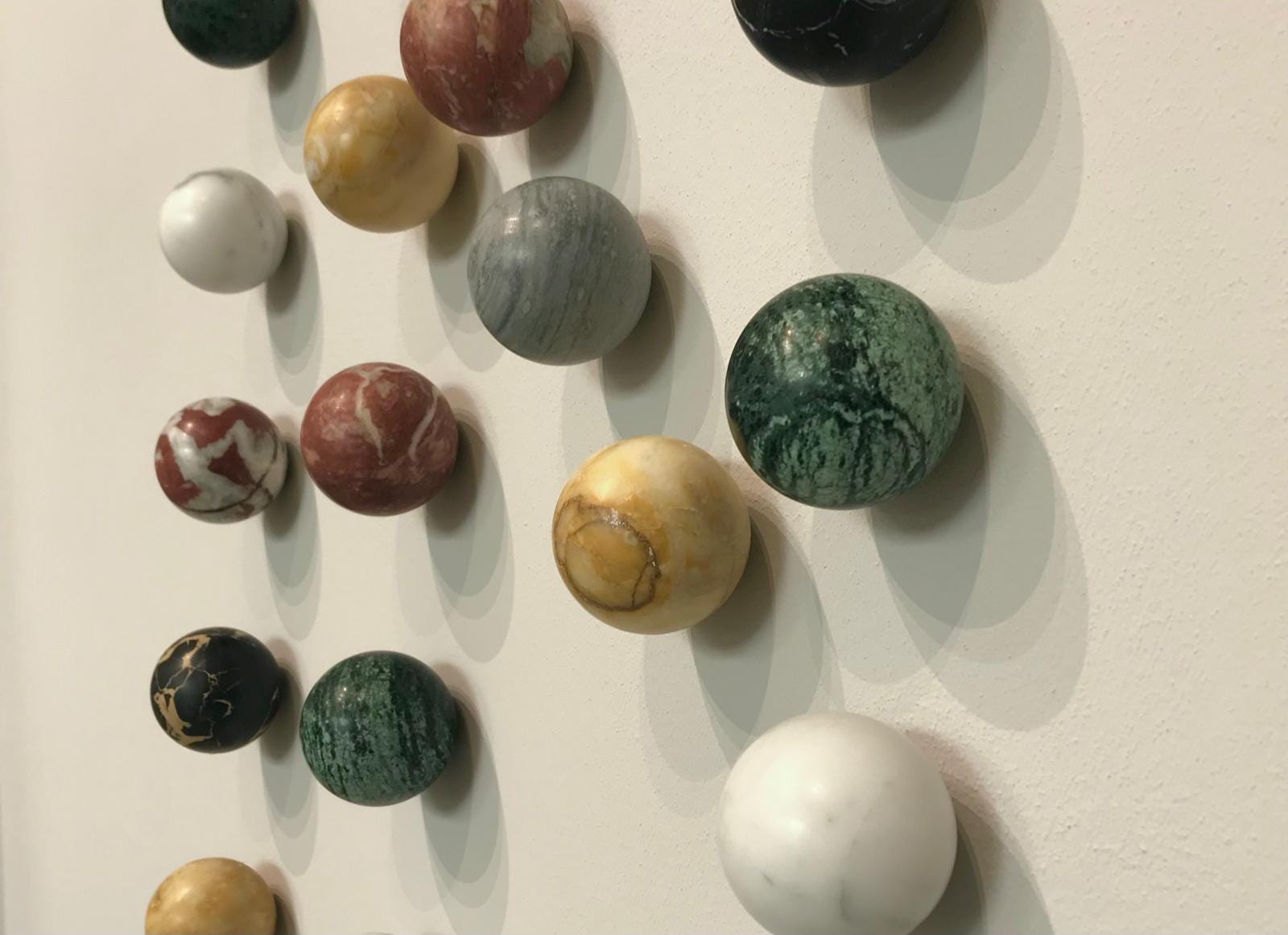
Marble is traditionally seen as a luxurious material in the art world, often tied to classical grandeur and weight. However, Saša approached it differently, using marble in a way that felt both delicate and playful, which was absolutely fascinating. The result was not just thoughtful and meticulously planned, but executed with a precision that left a lasting impression. It’s hard to believe that contrasting qualities—luxury, delicacy, and playfulness—could coexist in a single piece. But that’s what makes great art: the ability to combine the seemingly incompatible and make it work effortlessly.
Then, there’s the shepherd’s crook in the yard, like something out of the Garden of Eden, standing before you as a symbol, a guide, as you approach his work. It’s a harbinger, leading you to question who you are. And you’ll have no idea where your thoughts will take you unless you’re willing to let go and surrender to them. Hermes, the god of messages and transitions, also had a staff—a symbol of peace among the gods. It’s no coincidence that a double Gemini like Saša would choose a staff as a key element in the entrance guiding to his work that speaks so deeply of who we are. Clever, isn’t it?
After all is said and done, what I'm left with is inspiration. First of all, seeing someone like him work and gain the recognition he deserves gives me hope. Even though we may be a bit removed from the art world's spotlight back home in the rocks, it’s not impossible. It’s a long road—it took him 35 years—and it’s a road I now look at before me, hoping I’ll make the right choices and, one day, find myself in a similar place as an artist. But on the other hand, I’m also grateful for the memories he helped me rediscover—memories I had long forgotten, ones that seemed to have died with my grandfather and had overgrown with vines, whose fruits no one is left to harvest. Just like him, I want to keep that memory alive, that feeling of home I’m still struggling to define. Hermes fulfilled his purpose as a guidepost on the road of my destiny and artistic career, showing me the way forward when I felt it was impossible to continue when the fight seemed too great to endure. And being the gentleman he is, he opened the door at a pivotal moment. For that, I am deeply grateful. Through his art and presence, Saša reminded me not just of where I come from, but also of where I hope to go.